Farming is tough on equipment. A tractor works from dawn to dusk, pulling heavy loads through dust, mud, and crop residue. A combine harvester runs for weeks straight during harvest, processing acres of grain per hour. An irrigation system runs unattended for days. All this equipment relies on thousands of precision CNC machined parts OEM components that must survive abrasive soil, corrosive fertilizer, and constant vibration. China has become a major supplier of agricultural machinery parts, serving global brands like John Deere, CNH Industrial, AGCO, Kubota, and Claas, as well as the massive aftermarket for replacement parts. This guide walks through the key machined components for tractors, harvesters, planters, and implements, covering materials, tolerances, finishing, and practical tips for sourcing from Chinese manufacturers.
If you've machined parts for aerospace or medical devices, agricultural components might seem simpler. Tolerances are looser, surface finishes are rougher, and the paperwork is minimal. But farm equipment machining has its own brutal realities.
Abrasion is everywhere. Soil contains silica (sand). Silica is harder than steel. Every moving part that contacts soil—plow shares, cultivator sweeps, planter openers—wears down. Machined parts need to be made from wear-resistant materials or have hard coatings.
Corrosion is constant. Fertilizers (nitrogen, phosphorus, potassium) are corrosive. So is manure. So is standing water in paddy fields. Parts must resist rust and chemical attack.
Impact loads are high. A tractor hitting a hidden rock can transmit shock loads of many tons through the drivetrain. Gears, shafts, and housings need toughness, not just hardness.
Volume and cost sensitivity. A single tractor model might sell 50,000 units per year. Each tractor has dozens of machined parts. Suppliers need to produce millions of components annually at very low per-part costs.
Chinese CNC shops that excel in this space typically run 24/7 operations with multi-spindle lathes, automated forging or casting supply chains, and in-house heat treatment and plating. They understand that a failed part in the field means downtime during a narrow harvest window—so quality and consistency are paramount.
The heart of any tractor is its transmission. Whether it's a manual gearbox, a powershift, or a continuously variable transmission (CVT), it contains precision-machined gears, shafts, and housings. Tractor transmission components must handle high torque, shock loads, and thousands of hours of operation.
Typical components include:
Gear blanks (for hobbing or shaping after machining)
Transmission shafts (with splines, keyways, and bearing journals)
Shift forks and rails (machined from steel or ductile iron)
Clutch housings and pressure plates
Differential cases and spider gears
Transmission housings (often machined from cast iron or aluminum)
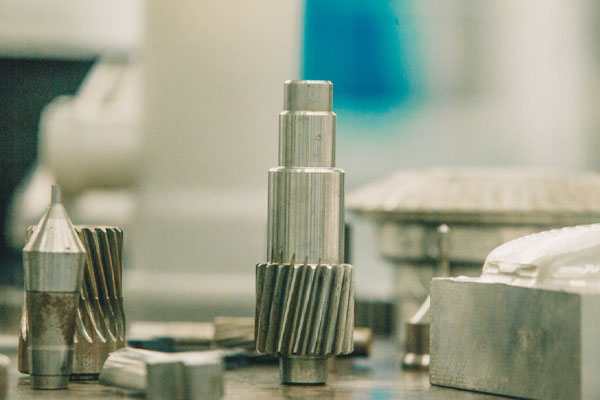
The most critical part is the transmission shaft. It's a long, stepped shaft with bearing journals, gear seats, splines, and often a drilled oil passage down the center. Typical material is case-hardened steel like 8620, 4320, or 20MnCr5. The process: turn the shaft to near-net shape, cut splines (rolling or milling), heat treat (carburize to 58-62 HRC on the surface, tough core), then grind the bearing journals and gear seats.
Tolerances for a transmission shaft:
Bearing journals: h6 (e.g., 50mm -0.016 to -0.025) with Ra 0.4μm finish
Gear seat diameters: h6 or h7, with surface finish Ra 0.8μm
Spline runout to bearing journals: 0.03mm TIR
Straightness: 0.05mm per meter
Oil hole deburring: no sharp edges that could shed debris into the hydraulic system
Chinese shops producing tractor transmission components need CNC lathes with live tooling (for cross-drilled oil holes), spline rolling or milling machines, cylindrical grinders, and in-house heat treatment. Some also offer gear hobbing as a secondary service.
Tractor transmission housings are typically cast iron (gray iron or ductile iron). Cast iron is cheap, machines well (the graphite acts as a lubricant), and dampens vibration. Chinese shops often receive rough castings from a foundry, then finish-machine them on horizontal machining centers (HMCs) or large vertical mills.
Critical features on a transmission housing include:
Bearing bores (often H7 tolerance, with alignment across multiple bores)
Mounting faces (flatness 0.05mm over the face)
Threaded holes (for cover plates and accessories)
Dowel pin holes (for alignment, typically H7 with 0.01mm position tolerance)
Oil passages (drilled and deburred)
Cast iron creates a lot of dust (graphite) during machining. Shops need good dust collection and coolant filtration. Also, cast iron is brittle—clamping forces must be controlled to avoid cracking thin sections.
A combine harvester or forage harvester cuts crops with a cutterbar—a long beam with reciprocating knife sections. The harvester knife sections (also called sickle sections) are small, stamped or machined steel triangles with serrated edges. They cut thousands of tons of crop over their life and need to be replaceable in the field.
Beyond the knife sections, the cutterbar assembly includes:
Knife heads (the moving bar that holds the knife sections)
Hold-down clips (keep the knife sections against the guards)
Guard plates (fixed fingers that the knife slides against)
Drive heads (connecting rod and eccentric mechanism)
The knife head (or sickle bar) is a long steel bar (up to 6 meters) with precision-punched or machined holes for attaching knife sections. The hole spacing must be consistent (typically 2-3 inches) to ensure proper cutting action. Chinese shops use CNC punching or drilling with indexing to maintain accuracy over long lengths.
Material for knife sections and guards is typically hardened steel (e.g., 1070 spring steel or 4140 heat-treated to 45-50 HRC). Some premium sections have a chrome or tungsten carbide coating on the cutting edge for longer life. Chinese suppliers often outsource coating to specialized shops; ask about their coating partners.
Tolerances for knife sections are not extremely tight (±0.2mm on hole positions, ±0.1mm on edge geometry) but consistency is critical. A section that's slightly out of position will bind or miss cutting.
Modern planters place seeds at precise spacing and depth. Planter components include seed meters, discs, openers, and depth-gauge wheels. Many of these are machined from plastics or aluminum to reduce weight and corrosion.
The seed meter is the heart of a planter. It singulates seeds—one at a time—and drops them into the furrow. Machined parts in a seed meter include:
Meter housing (aluminum or plastic)
Seed disc (machined with pockets or holes to hold individual seeds)
Singulator (a small plastic or metal part that knocks extra seeds off)
Ejector wheel (pushes seeds out of the disc)
The seed disc is a precision part. It's a flat disc (150-300mm diameter) with dozens of precisely machined pockets or holes around the circumference. The pockets must be identical in size and depth to within ±0.02mm. If a pocket is too deep, it picks up two seeds. Too shallow, it picks up none. Chinese shops that produce seed discs often use CNC milling with custom fixtures, then inspect every pocket with a vision system.
Material for seed discs is often acetal (POM) or nylon for corn and soybean planters, or aluminum for high-speed planters. Plastic discs are cheaper but wear faster. Aluminum discs are more durable but can damage seeds if edges are sharp.
Other planter parts include opener discs (steel discs that cut a furrow). These are stamped or machined from high-carbon steel and heat-treated to 45-50 HRC. They have a precise bevel on the edge and a center hole for mounting.
Modern tractors and implements use hydraulics for steering, lift arms, brakes, and auxiliary functions. Hydraulic components for agriculture include cylinder bodies, pistons, valve blocks, and fittings. These parts must withstand high pressures (up to 3000 psi) and resist corrosion from fertilizer and moisture.
Examples include:
Hydraulic cylinder barrels (seamless steel tube, honed to final size)
Piston rods (chrome-plated steel, turned and ground)
Valve spools and housings (precision-machined from steel or cast iron)
Quick coupler bodies (with ball detents or poppet valves)
Fittings and adapters (machined from steel or brass)
The hydraulic cylinder barrel is a thick-walled tube (usually cold-drawn seamless steel like 1026 or 4130). After turning the ends, the inside diameter is honed or roller-burnished to achieve a smooth surface (Ra 0.2-0.4μm) with a precise size (H8 or H9 tolerance). The bore must be straight and round. Chinese shops that specialize in hydraulic cylinders have dedicated honing machines and can produce barrels up to 2 meters long.
The piston rod is a long steel shaft (hard chrome plated) that extends from the cylinder. It's turned from 1045 or 4140 steel, ground to h6 or h7 tolerance, then hard chrome plated (20-30 microns thick) and polished to Ra 0.1-0.2μm. Chrome plating is a specialized process—many Chinese shops outsource it. Ask about their plating partner's quality (adhesion, thickness, hardness, salt spray resistance).
Valve spools are precision-ground parts with small clearances (0.005-0.015mm) to control oil flow. They require cylindrical grinding and often have cross-drilled holes for oil passages. The spool-to-bore clearance is critical—too tight and the valve sticks; too loose and it leaks. Chinese shops making valve spools need lapping or honing capability.
Tillage tools—plows, cultivators, discs, harrows—cut through soil. Their ground-engaging wear parts are designed to be replaced regularly. These parts are often machined from high-carbon or alloy steel, then heat-treated for hardness.
Examples include:
Plow shares (the cutting edge of a moldboard plow)
Cultivator sweeps (V-shaped blades)
Disc blades (concave discs that cut and turn soil)
Chisel plow points (replaceable tips)
Planter opener blades (double-disc openers)
These parts are typically stamped or machined from heat-treated boron steel (e.g., 30MnB5 or 27MnCrB5) or quenched and tempered steel (e.g., Hardox 400/450/500). The hardness ranges from 40-55 HRC depending on the abrasiveness of the soil. For very abrasive soils (sandy), some parts have tungsten carbide hardfacing applied to the leading edge. Chinese shops that specialize in wear parts will have in-house heat treatment (furnaces for austenitizing and quenching) and possibly hardfacing (welding) capability.
Tolerances on wear parts are generally loose (±0.5mm on thickness, ±1mm on hole positions) because they're designed to wear and be replaced. However, bolt hole positions must be accurate enough to fit standard mounting patterns (e.g., 4-bolt pattern with 100mm spacing).
A disc blade is a concave steel disc (diameter 18-32 inches) with a beveled edge. It's formed from a flat blank in a press, then heat-treated, then sometimes machined on the center bore and mounting holes. Chinese suppliers typically start with a stamped blank, then turn the center bore and drill mounting holes on a CNC lathe. The disc then goes through austenitizing, quenching, and tempering to achieve hardness (45-55 HRC on the edge, softer in the center).
Quality issues with disc blades often relate to hardness inconsistency (soft spots that wear quickly) or warping during heat treatment (causing wobble). Ask your supplier about their heat treatment process control and how they check hardness (Rockwell testing at multiple locations).
Here's a practical guide to materials for different agricultural applications:
Steel 8620, 4320, 20MnCr5 for transmission gears and shafts that need a hard case (58-62 HRC) and tough core. Case-hardenable.
Steel 4140, 4340 for high-strength shafts and pins that are through-hardened (35-45 HRC). Good toughness and fatigue resistance.
Steel 1045, 1050 for general-purpose shafts and pins that are induction-hardened on bearing surfaces. Lower cost than alloy steels.
Steel 1070, 1080 for knife sections and wear parts that need high hardness (50-55 HRC). Spring steel.
Boron steel (30MnB5, 27MnCrB5) for wear parts that need high hardenability at lower cost. Common in disc blades and cultivator sweeps.
Gray cast iron (ASTM A48 Class 30-40) for transmission housings, differential cases, and hydraulic valve bodies. Good vibration damping, machinable, low cost.
Ductile iron (ASTM A536 65-45-12) for higher-strength housings and brackets that need some ductility.
Aluminum 6061-T6 for lightweight components like planter meter housings and some hydraulic valve blocks (low pressure).
Acetal (POM, Delrin) for seed discs, bushings, and wear pads. Good machinability, low friction, resists chemicals.
Nylon 6/6 for similar applications but absorbs moisture and swells. Use only if dry operation.
Stainless steel 303, 304, 316 for fertilizer-handling components (spreaders, injectors). 316 is best for corrosion resistance but harder to machine.
Agricultural parts often receive surface treatments to resist corrosion and wear:
Zinc plating (clear or yellow) for steel brackets, fasteners, and hydraulic fittings. Clear zinc is standard; yellow zinc offers slightly better corrosion resistance. Salt spray rating: 72-120 hours to white rust.
Zinc-nickel plating for higher corrosion resistance (500+ hours salt spray). More expensive, used for components exposed to fertilizer.
Phosphate coating for gearbox internals that need oil retention. Often used with oil dip for short-term corrosion protection.
Black oxide for cosmetic appearance and mild corrosion resistance on steel parts. Not suitable for outdoor exposure without oil.
Hard chrome plating for hydraulic piston rods and bearing journals. Provides hardness (70 HRC) and corrosion resistance. Thickness 0.02-0.05mm.
Electroless nickel plating for uniform hardness and corrosion resistance on complex shapes. Good for fertilizer exposure.
Paint or powder coating for housings and brackets. Provides good corrosion protection but can chip. Powder coating is thicker and more durable.
Tungsten carbide hardfacing for wear parts in abrasive soil. Applied by welding (PTA or oxy-acetylene) to the leading edge. Very durable but expensive.
When specifying finishes for agricultural parts, consider the environment. A part that will be used in a dry grain region needs less corrosion protection than one used in a wet paddy field or exposed to liquid fertilizer.
Quality expectations for agricultural parts are generally lower than aerospace or medical, but consistency is critical. A batch of shafts that are 0.05mm oversize might still work, but if half are oversize and half are undersize, assembly becomes impossible. Chinese suppliers use various methods to maintain consistency:
First article inspection (FAI): Complete dimensional check of the first part from each production run, using CMM, micrometers, and gauges.
In-process sampling: Checking critical dimensions (bearing journals, spline dimensions) at regular intervals (every 20-50 parts).
Hardness testing: Rockwell or Brinell testing on a sample from each heat treat batch.
Case depth measurement: For carburized parts, checking effective case depth on a sample (microhardness traverse or break test).
Magnetic particle inspection (MPI): For critical shafts and gears to detect surface cracks after heat treatment.
For high-volume parts, Chinese shops often use air gauges for fast, accurate bore measurement, and vision systems for checking hole presence and position. Ask about their inspection equipment and sampling plan before placing a large order.
Here's a practical selection process:
Step 1: Look for agricultural experience. Ask if they have made parts for tractors, harvesters, or implements. Request references or case studies. A shop that understands the wear and corrosion requirements is more likely to succeed.
Step 2: Check their material and heat treatment capabilities. Do they have in-house heat treatment (carburizing, through-hardening, induction hardening)? Do they work with cast iron, steel, aluminum, and plastics? Can they source the specific alloys you need (e.g., 8620, 30MnB5)?
Step 3: Evaluate their secondary operations. Do they offer plating, painting, or hardfacing? Outsourcing finishing adds lead time and risk. Shops with in-house finishing are preferred.
Step 4: Assess their production capacity. What is their typical batch size? Do they have multi-spindle lathes or horizontal machining centers for high volume? Can they handle your annual volume?
Step 5: Request a sample run. Order a small quantity (50-200 pieces) to evaluate quality, lead time, and communication. Use this trial to validate their processes before scaling to full production.
Many Chinese suppliers for agricultural parts are located in Shandong province (the "agricultural machinery capital"), Henan province, and Zhejiang province. The city of Linyi in Shandong is a major hub for farm equipment manufacturing.
Agricultural parts are cost-sensitive. Here are rough benchmarks for high-volume pricing (10,000+ pieces per year):
Transmission shaft (steel, 300mm long, turned and ground): $3-6 each
Planter seed disc (aluminum, 250mm diameter, machined pockets): $2-4 each
Hydraulic cylinder barrel (steel tube, 50mm bore x 500mm length, honed): $5-10 each
Cultivator sweep (heat-treated boron steel, stamped and formed): $1.50-3 each
Cast iron transmission housing (machined from casting): $15-30 each
Lead times: For parts requiring new tooling (fixtures, custom cutters, patterns), add 4-8 weeks for tooling. Production lead times: 4-6 weeks for first article, then 3-5 weeks for production batches. Heat treatment and plating add 1-2 weeks. Shipping: air freight 3-7 days, sea freight 30-45 days.
Minimum order quantities for cost-effective pricing are typically 1,000-5,000 pieces for machined parts, higher for castings or forgings (5,000-10,000). Some shops accept smaller orders (100-500 pieces) at higher per-part prices (2-3x).
Based on real sourcing experience, here are frequent issues with agricultural parts from China:
Inconsistent hardness on wear parts. Some sweeps or disc blades are soft and wear quickly. Prevention: specify hardness range (e.g., 45-50 HRC) and require hardness test reports (Rockwell) on a sample from each heat treat batch.
Poor chrome plating adhesion. Piston rod chrome flakes off. Prevention: require plating specifications (e.g., thickness 0.03mm, hardness 800-900 HV, adhesion test by bend or cross-hatch). Ask for a sample part to test.
Cast iron porosity. Transmission housings leak oil. Prevention: work with a shop that does pressure testing (e.g., 10 psi air under water) on a sample from each batch. Specify porosity limits (e.g., no visible pinholes larger than 1mm).
Thread damage during shipping. Zinc-plated fittings arrive with cross-threaded or damaged threads. Prevention: specify thread protectors (plastic caps) on all threaded features. Also, require packaging that prevents parts from contacting each other.
Warped disc blades. Discs wobble when rotated. Prevention: specify flatness or runout tolerance (e.g., 1mm TIR at rim) and require inspection on a surface plate.
The agriculture industry is evolving, and Chinese shops are adapting:
Precision farming. Variable-rate technology, GPS guidance, and section control require more precise machined components (e.g., metering rollers, encoder mounts). Tolerances are tightening.
Electrification. Electric tractors and autonomous vehicles are emerging. This will shift demand from hydraulic components to electric motor housings and battery enclosures—more aluminum machining.
Lighter materials. To reduce soil compaction, manufacturers are using more aluminum and high-strength plastics. Shops need to become proficient with these materials.
Additive manufacturing for wear parts. Some wear parts (like plow points) are being 3D printed in wear-resistant alloys, then finish-machined. This is still niche but growing.
Just-in-time supply. As farm equipment manufacturers reduce inventory, they expect shorter lead times from suppliers. Chinese shops are investing in faster changeover and lean production.
Sourcing agricultural machinery parts from China is a well-established practice. The supply chain is mature, costs are competitive, and quality can be excellent if you choose the right partner. The key is finding a shop that understands the unique demands of agriculture: abrasion, corrosion, impact, and high volume. Start with a trial order, verify their heat treatment and finishing capabilities, and build a relationship for the long term.
Need help sourcing precision machined parts for tractors, harvesters, or implements? Send us your drawings and annual volume estimates. We work with a network of Chinese CNC shops that specialize in agricultural components—from transmission shafts to seed discs to hydraulic cylinders. Free DFM feedback and quoting available.
A: For very abrasive sandy soil, use boron steel (e.g., 30MnB5) heat-treated to 50-55 HRC, with tungsten carbide hardfacing on the leading edge. The hardfacing dramatically extends life (2-3x compared to uncoated steel). For less abrasive soil, a through-hardened steel like 1070 (50 HRC) may suffice.
A: Yes, many specialize in cast iron machining. They typically receive rough castings from a foundry (often in the same industrial zone) and finish-machine on horizontal machining centers. Look for shops with experience in gray iron and ductile iron. Ask about their coolant and dust management—cast iron dust can be abrasive and requires filtration.
A: Typical spool-to-bore clearance is 0.005-0.015mm for a lapped fit. The spool diameter should be ground to h5 or h6 tolerance (e.g., 20mm -0.005 to -0.011). The surface finish on the spool and bore should be Ra 0.1-0.2μm. Not every Chinese shop can hold these tolerances—ask specifically about their cylindrical grinding and lapping capabilities.
A: Specify the material, the heat treatment process (e.g., austenitize at 850°C, oil quench, temper at 400°C), and the final flatness (e.g., 1mm TIR at rim). Also specify that the disc should be clamped during heat treatment or use a press quench to minimize distortion. Ask the supplier for a process flow and quality control plan.
A: Some can. Zinc-nickel (12-15% nickel) is more common in automotive applications but available in China for agricultural parts. Ask for salt spray test results (typically 500+ hours to red rust). Also verify that the plating is applied after heat treatment (to avoid hydrogen embrittlement) and that the parts are baked to remove hydrogen.
A: For a honed tube (seamless steel), MOQs of 500-2000 pieces are typical because the tube must be ordered from the mill in specific sizes. For smaller quantities, the shop may have stock tubing in standard sizes, but your diameter and length must match. Plan ahead.
A: Require a first article inspection report that includes pocket depth measurements (e.g., all 24 pockets measured). Also require a vision inspection system report showing pocket position and geometry. For ongoing production, ask for statistical process control (SPC) data on a sample of pockets from each batch.
A: Yes, Hardox is a branded quenched and tempered steel (similar to Chinese grades like NM400, NM500). It's hard (40-50 HRC) and requires rigid machines and carbide tooling. Many Chinese shops are familiar with it because it's widely used in mining and construction equipment. Ask about their experience with specific Hardox grades.
A: For a rod that runs in a polyurethane seal, Ra 0.1-0.2μm is typical. For a rod with a bronze bearing, Ra 0.2-0.4μm is acceptable. Specify the finish and require a profilometer report for first article. Also specify the chrome plating thickness (usually 0.02-0.05mm) and hardness (800-900 HV).
A: Search on Alibaba using terms like "tractor transmission shaft," "combine harvester knife section," or "planter seed disc." Look for suppliers that mention "agricultural machinery parts" and have photos of farm equipment. Also check trade shows like Canton Fair (Phase 3, which includes agricultural machinery) or Agritechnica Asia. Many shops are located in Linyi (Shandong), Luoyang (Henan), and Yongkang (Zhejiang).
Ready to source precision machined parts for your agricultural equipment? Contact us with your drawings and annual volumes. We'll match you with qualified Chinese CNC shops that specialize in tractor, harvester, and implement components—from wear parts to hydraulic cylinders. Free quoting and DFM feedback available.

Phone&WhatsApp:+86 13410452313
Email:gavinlee@zhuoguanmetal.com
Address: Room 805-1, Building A, Block 1, Xingzhan Plaza, No. 446, Shajing Nanhuan Road, Shatou Community, Shajing Street, Bao'an District, Shenzhen, Guangdong, China 518104